After 17 years of helping seniors downsize, move, and settle into new homes, I’ve learned a thing or two about people and their possessions. I’ve seen beautiful antiques that nobody wanted, boxes of photographs that brought families to tears, and entire collections carefully accumulated over decades that were suddenly worth very little. But perhaps the most interesting thing I’ve learned is that the things we own often mean something very different to us than they do to the people who will eventually inherit them. And that’s something to think about.
Sometimes its the Little Things….
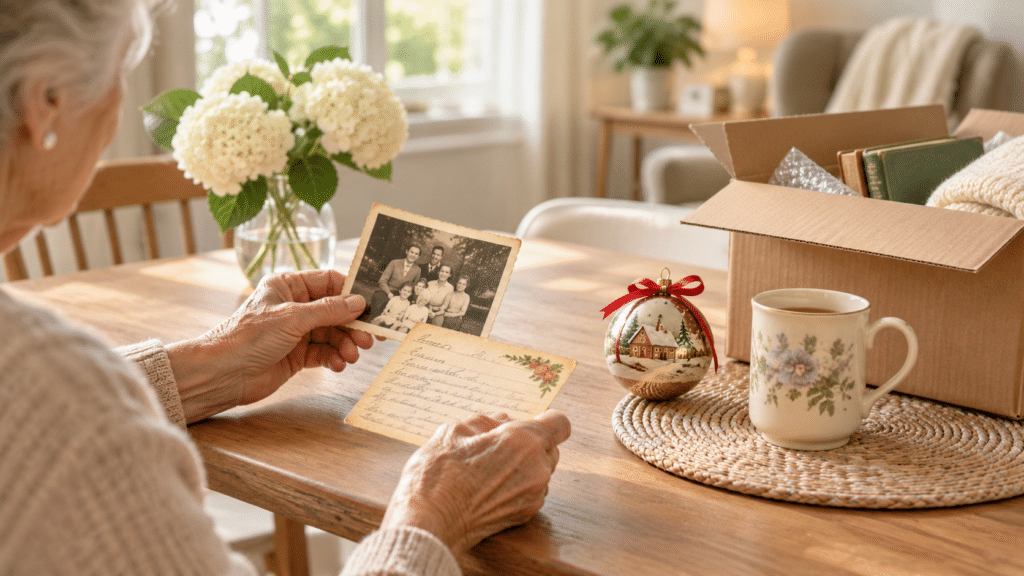
When families are sorting through a lifetime of possessions, it’s not always the expensive things that matter. It might be a handwritten recipe for Grannie’s Mac and Cheese. A photograph long forgotten in the back of a drawer. Dad’s fishing rod. A little ornament that appeared on the tree each Christmas. These are the things that can stop someone in their tracks. They’re often worth almost nothing financially, but they’re irreplaceable to the people who love them. It’s a good reminder that when we’re deciding what to keep, what to give away, and what to sell, we shouldn’t automatically assume that the most expensive items are the most important. Sometimes a shoebox of photographs is worth more to a family than an entire dining room full of furniture.
Our Kids Don’t Necessarily Want Our Stuff
One of the biggest changes I’ve observed over the years is how differently generations value possessions. Many of today’s seniors grew up in households where quality furniture, fine china, silverware, and crystal were treasured. These were things people saved for, cared for, and expected to pass along to their children. But times have changed. Today’s younger generations often have smaller homes, different decorating styles, and little interest in maintaining collections of things they rarely use. The beautiful china cabinet that was once a prized possession may have no interested takers. The formal dining room suite that cost thousands of dollars might be difficult to sell for a fraction of its original price. This can be very upsetting for people who assumed their possessions would be treasured by the next generation. But here’s something I’ve come to understand: our children don’t have to want our possessions to value the lives we’ve lived. They may not want the dining room table, but they probably remember the years of Christmas dinners they had with you at it.
Sentimental Value and Market Value Are Two Very Different Things
This is one of the more difficult conversations we have with clients. An item might have been expensive when it was purchased, beautifully maintained, and genuinely valuable to its owner. Unfortunately, none of these things guarantees that someone else will want to buy it today. The resale market is driven by demand, not by what something originally cost or how much it means to the person selling it. Some things surprise us by selling exceptionally well. Others, despite their quality and craftsmanship, attract very little interest. After years of helping families disperse household contents, I’ve learned that it’s best to approach the process with an open mind and realistic expectations.

The Older We Get, the Less Our Possessions Seem to Matter
One of the more surprising things I’ve noticed is that the older people get, the less attached they often are to their possessions. We tend to assume the opposite—that someone who has lived in a home for 50 years will find it almost impossible to part with the things they’ve accumulated. But that hasn’t been my experience. Often, it’s our oldest clients who are the most matter-of-fact about letting things go. They know what they need, they know what they enjoy, and they’re quite happy to leave the rest behind. Perhaps it’s the perspective that comes with age. After a lifetime of acquiring, collecting, and caring for possessions, priorities begin to shift. The things that once seemed so important simply don’t carry the same weight anymore. Of course, everyone is different, and letting go can be difficult at any age. But I’ve come to appreciate the wisdom of people who have reached a point where they no longer feel defined by what they own.
You Don’t Have to Wait Until You’re Moving
One of the things I wish more people understood is that you don’t need to be planning a move to start thinking about your possessions. In fact, the best time to begin is often when you’re healthy and under no pressure to make decisions. Ask your children whether they actually want the things you’ve been saving for them. You might be surprised by their answers! Give things to people who will appreciate them now, when you can enjoy seeing them used. Do your kids a favor – label the photographs! Write down the stories behind meaningful objects. Pass along the family recipes. And perhaps most importantly, give yourself permission to let go of things that no longer serve a purpose in your life. You don’t have to keep something simply because you’ve owned it for 40 years or because it was expensive when you acquired it (or because it was a gift).
What 17 Years Has Taught Me
If there’s one thing I’ve learned from spending so many years helping people through these transitions, it’s that the memories are far more important than the things themselves. Our homes and possessions are part of our stories, but they aren’t the whole story. The furniture will eventually find another home. The dishes will be sold, donated, or passed along. Some of our belongings will be treasured by the next generation, and others won’t.
And that’s okay. What matters most isn’t how much we leave behind, but the memories, relationships, and experiences that made those things meaningful in the first place. After 17 years in this business, I still find that a deeply meaningful lesson.
Home Again Seniors Transition Services has been helping seniors and their families navigate downsizing, moving, estate clearing, and household dispersals throughout Greater Victoria and Southern Vancouver Island for 17 years. We understand that moving is about much more than simply moving belongings—and we’re here to make the process easier.
← Back to all articles